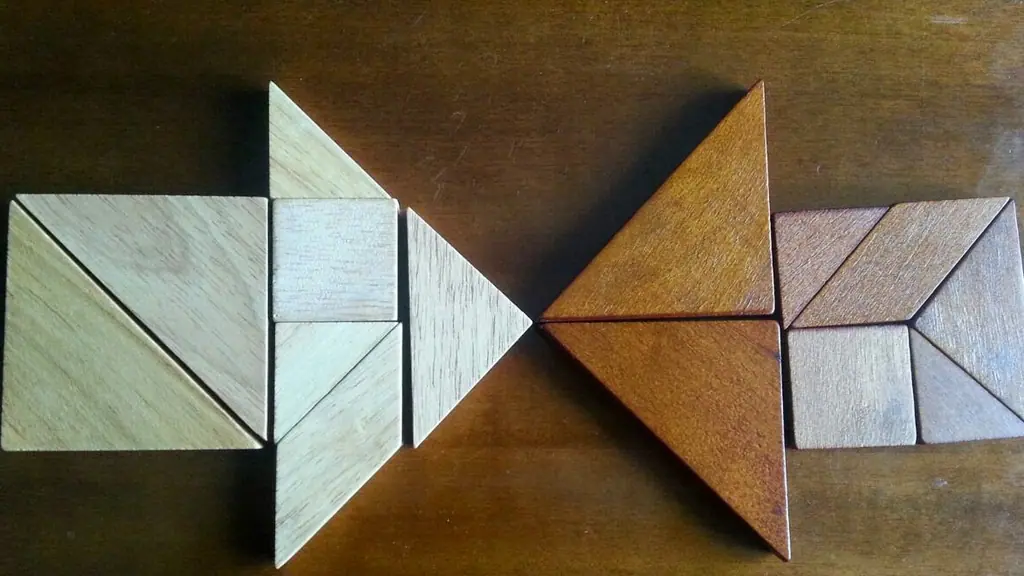
Seven flat pieces: five triangles, a square and a slanted parallelogram. Put them together one way and they make a square. Put them together another way and they make a running cat, a sailing boat, a house or a person sitting down. That is the whole of the tangram, and it has kept people busy for more than two hundred years.
Tangrams are cheap, quiet, portable and endlessly varied. A set made from a cereal box works as well as a polished wooden one. They suit a four-year-old matching pieces to a drawing and an adult stuck on a tricky silhouette. This guide explains where the puzzle came from, how to make a set, how to move from easy to hard, and what research does and does not say about shape puzzles and spatial skills.
The seven pieces
Every tangram set has the same seven pieces, all cut from one square:
| Piece | How many | Size compared with a small triangle |
|---|---|---|
| Large triangle | 2 | 4 times the area |
| Medium triangle | 1 | 2 times the area |
| Small triangle | 2 | 1 (the basic unit) |
| Square | 1 | 2 times the area |
| Parallelogram | 1 | 2 times the area |
The traditional rules are short. The Library of Congress's family guide to tangrams puts them simply: use all seven pieces, make sure they all touch, and do not let them overlap. Pieces may be turned, and the parallelogram may be flipped over, which is one of the first discoveries many players make.
A short history: from China to a 19th-century craze
The tangram's exact origin is uncertain, but its documented history begins in China. According to the Lilly Library at Indiana University, which holds the large Jerry Slocum puzzle collection, the earliest known book of tangram problems is a Chinese publication from 1813. A Chinese book of problems and solutions from 1815 reached London, and in 1817 London publishers reprinted it with English titles. Translations followed across Europe, the craze was especially strong in France, and it peaked in 1818. A mathematician at UNSW Sydney, writing for The Conversation, describes the puzzle being popularized in China around 1800 and the craze spreading through European countries in 1817 and 1818.
Tangrams later found a place in education. The Lilly Library notes that German tangram publications led to their use in early kindergarten teaching. Today they appear in school mathematics materials in many countries, including activities from the New South Wales Department of Education in Australia that ask young children to build designs from the pieces and then invent their own.
You may read that the tangram goes back much further. Both the Library of Congress and the UNSW mathematician suggest possible roots in the third century, when the Chinese mathematician Liu Hui explained geometry by cutting and rearranging shapes. Rearrangement puzzles are certainly old, but the seven-piece tangram itself is only documented from the early 1800s, and the earliest known tangram books date from the 1810s.
Make a set from card in ten minutes
You need a square of stiff card (a cereal box works), a ruler, a pencil and scissors. A 16 cm (about 6 inch) square is a comfortable size.
- Draw a light grid. Divide the square into a 4×4 grid of small squares. Call the bottom-left corner (0,0) and the top-right corner (4,4); the first number counts across, the second counts up.
- Draw the main diagonal from (0,0) to (4,4).
- Split the top-left half. Draw a line from the center (2,2) to the top-left corner (0,4). You now have the two large triangles.
- Cut off the medium triangle. Draw a line from (2,0), the middle of the bottom edge, to (4,2), the middle of the right edge.
- Mark the square. Draw a line from the center (2,2) to (3,1), then from (4,2) to (3,3). The four points (2,2), (3,1), (4,2) and (3,3) make the square, and the corner above it at (4,4) is a small triangle.
- Finish the last two pieces. Draw a line straight across from (3,1) to (1,1) on the diagonal. Above it is the second small triangle; below it is the parallelogram.
- Cut along the lines and rub out the grid marks. Coloring both sides the same color makes flipping the parallelogram less confusing.
Healthy play
Safety. Adults should do any cutting with a craft knife; younger children can cut thick lines with safety scissors and help. Keep pieces large for toddlers, since small pieces can be a choking hazard, and supervise very young children while they play.
From easy to hard: a five-stage path
Tangram puzzles range from very easy to fiendishly hard, and the difference is almost entirely in how much information the picture gives you. Moving through these stages lets each child find a level that feels challenging but possible.
- Outline with all the lines. The picture shows every piece drawn in place, at full size. The child matches each piece to its spot. This is mainly about recognizing shapes and turning them to fit.
- Outline with some lines. Only a few internal lines are shown, so the child has to work out where the rest go.
- Silhouette at full size. Just the solid outline, the same size as the pieces. Now the player has to imagine how the pieces divide the shape.
- Small silhouette. The outline is printed smaller than the pieces, so the player must also scale up in their head. Most adult puzzle books use this format.
- Invent and swap. Make your own figure, trace around it, and challenge someone else to solve your silhouette.
Try this
Family challenges. Race to make the biggest possible triangle using any number of pieces. Make the letters of your name. Try building a square from just the two small triangles, then from five pieces, then all seven. Or set a theme, such as animals or vehicles, and share the results at dinner.
What the evidence says, and what it does not
Tangrams are usually described as good for "spatial skills", the ability to picture shapes, rotate them in your head and understand how parts make up a whole. It is worth being precise about the evidence.
What the evidence says
Close cousins of tangrams go hand in hand with spatial and math skills. When 102 three-year-olds copied small block models in a 2014 Child Development study, how accurately they built accounted for roughly 15% of the variation in their math scores, measured at the same time. In a 2012 home-observation study of 53 toddlers, those seen doing jigsaw puzzles later scored higher on a shape-transformation task at age 4½. Neither study can show cause and effect; they show that the skills travel together.
Practice moves spatial scores. Pooling 217 training studies with children and adults, a 2013 Psychological Bulletin meta-analysis found that trained groups outscored control groups by a moderate margin on average. The benefit was still there at delayed tests and showed up on related spatial tasks nobody had practiced, though none of the studies tested tangrams as such.
What we do not know. There is far less research on tangrams specifically, and we cannot say how much any particular amount of tangram play will improve a particular child's skills. Treat tangrams as an enjoyable way to practice shape thinking, not as a guaranteed boost to math grades.
One practical point from the research is worth carrying into play: talk. The 2014 study also found that lower-income parents reported using fewer spatial words with their children. Words like "rotate", "flip", "edge", "corner", "above" and "next to" give children the language to describe what they are doing, and tangrams are a natural place to use them.
Where to go next
If tangrams click, try our Spatial Rotation game, which asks you to spot a shape that has been turned rather than flipped, the same distinction you meet with the tangram's parallelogram. For the bigger picture of what spatial thinking is and why researchers study it, read our parent's guide to spatial reasoning. Ideas for mixing card puzzles with screen-based ones are in offline and online puzzles at home, and you can browse more in our spatial thinking topic.
Sources
- Mechanical puzzle category spotlight 1: put-together puzzles, Lilly Library, Indiana University
- The history and mystery of Tangram, the children's puzzle game that harbours a mathematical paradox or two, The Conversation (Thomas Britz, UNSW Sydney)
- Craft, create, calculate: bring geometry to life with the tangram, Library of Congress
- Tangrams puzzles, Early Stage 1, NSW Department of Education
- Deconstructing building blocks: preschoolers' spatial assembly performance relates to early mathematical skills (Verdine et al., 2014), Child Development, via PubMed Central
- The malleability of spatial skills: a meta-analysis of training studies (Uttal et al., 2013), Psychological Bulletin, American Psychological Association