A maze asks one of the oldest questions a puzzle can ask: how do I get from here to there? There are no numbers to calculate and no words to read, just walls, gaps and a goal. That is why a four-year-old can try one, and also why a big hedge maze can keep a group of adults wandering for an hour.
Mazes are also a small, safe version of something we do every day: finding our way. Following a route to school, reading a map at a theme park, or giving directions to a friend all involve holding a picture of space in mind and making choices inside it.
This guide covers where mazes came from, the main ways to solve them (including the popular rule that fails in some mazes), how to draw mazes with children, and how to move from paper mazes to real maps outdoors.
Mazes and labyrinths are not quite the same thing
In everyday English the two words are often swapped, but many maze enthusiasts and historians draw a useful line between them:
- A labyrinth has a single winding path. You cannot get lost; you simply follow it to the center and back out. The technical word is unicursal (one course).
- A maze has branches, choices and dead ends. It is a puzzle meant to be solved, and getting lost is part of the experience.
The National Building Museum's short history traces labyrinth designs across many ancient cultures. Coins from Knossos on Crete showing a labyrinth date to around 400 BCE, linked to the myth of the Minotaur, and the famous pavement labyrinth at Chartres Cathedral in France was built in the 13th century. Those designs are labyrinths in the strict sense: single paths, often walked slowly and thoughtfully.
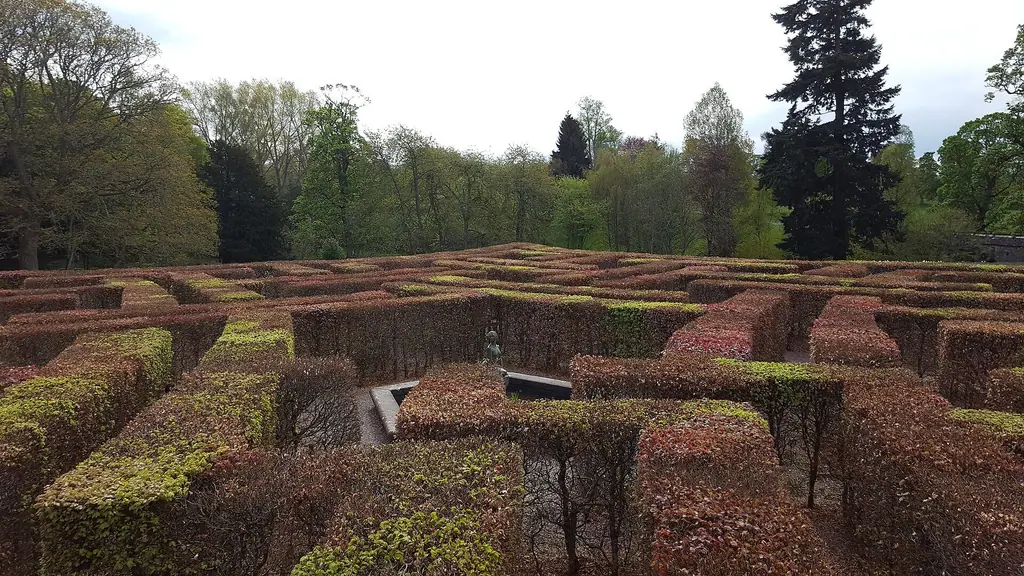
The branching puzzle maze became popular much later in garden design. Hedge mazes were a feature of British formal gardens, and the maze at Hampton Court, planted in hornbeam in 1690 for William of Orange, still exists. Hedge mazes were especially fashionable in 18th-century England before tastes shifted toward more "natural" landscape gardens. Today the tradition lives on in corn mazes, ice mazes at winter festivals, puzzle books and browser games.
For children, the distinction is a nice first lesson in classification: is this a one-path labyrinth or a choose-your-way maze? Drawing one of each is a good way to find out.
Three ways to solve a maze
Most people solve small mazes by eye: they look ahead, spot the dead ends and trace a line. That works well on paper. For bigger mazes, or for walking through a real one where you cannot see over the walls, a method helps.
| Method | How it works | Works best for | Watch out for |
|---|---|---|---|
| Wall follower | Keep one hand on a wall (always the right, or always the left) and keep walking | Mazes where every wall connects to the outside edge | Can fail if you start, or the goal sits, beside a "wall island" not joined to the outer edge |
| Dead-end filling | On paper, shade in every dead end, working back to the nearest junction, until only the route remains | Printed mazes you can see all at once | Needs a view of the whole maze, so not for walk-through mazes |
| Work backward | Start at the goal and trace the path back toward the start; or solve from both ends at once | Mazes where the start has many branches but the goal has few | Easy to lose your place without marking the path |
Why the wall follower sometimes fails
The wall-follower rule feels like magic the first time: put your right hand on the wall, never let go, and you will eventually come out. It works because, in many mazes, all the walls are joined into one continuous piece connected to the outer edge. Following that piece is like tracing around the edge of a giant shape: you will pass every point along it, including the exit.
But some mazes contain loops, where a section of wall stands on its own like an island. If you start next to an island, or the goal sits in the middle of the maze on one, the wall follower can walk you in a circle forever. Some puzzle mazes with a central goal are deliberately built this way. For those, you need to mark your route: chalk on paper, a ribbon in the real world, or mental notes about which branches you have already tried.
Try this
Ask an older child to explain why the right-hand rule works, using a drawn maze. Then challenge them to design a maze where it fails. Building a counterexample is a satisfying piece of reasoning, and the answer (an island of wall around the goal) is easy to check.
What mazes ask of a player
Solving a maze involves several things happening at once. You scan ahead for promising paths, hold a rough map in mind, resist the urge to dash down the first corridor, notice when you have hit a dead end, and back up without getting upset. Harvard's Center on the Developing Child lists puzzle books that include mazes among activities that give children aged around 5 to 7 practice with attention and problem-solving.
It is tempting to go further and say that mazes "build" spatial intelligence or boost math scores. The research does not let us say that about mazes specifically.
What the evidence says
Spatial skills can improve with practice, but mazes themselves are not well studied. A large meta-analysis by Uttal and colleagues (2013) combined 217 studies of spatial training. On average, training improved spatial performance compared with control groups, the gains held up over delays, and they transferred to other spatial tasks that had not been trained. That is a strong, broad body of evidence that spatial skills are not fixed. However, the studies used many kinds of training (mental rotation, video games, coursework), not mazes in particular, and transfer to math or school grades was not what they measured directly. A fair summary: mazes are a fun way to practice spatial planning, without promises about wider effects.
For more on what spatial reasoning includes and how it develops, see our guide on what spatial reasoning is.
Drawing mazes together
Children often enjoy making mazes even more than solving them, and drawing one makes the structure of a maze visible. Here is a simple method that works from about age six, with an adult helping younger children.
- Draw a grid of squares on paper, around 5 by 5 for a first attempt. Mark a start square on one edge and a finish square on another.
- With a colored pencil, draw the solution: a winding path from start to finish through the grid. It should not cross itself.
- Add two or three side branches off the solution path that wander away and stop. These are your dead ends.
- Fill the rest of the grid with more branches until every square belongs to some path.
- Go over the grid lines in pen, leaving gaps only where your paths pass from one square to the next. Those lines become the walls.
- Erase or hide the colored solution, then swap mazes with someone and solve each other's.
Once a child has made one or two, try variations: a circular maze drawn on rings, a maze where the goal is in the middle (does the wall follower still work?), or a labyrinth with only one path. Building puzzles for others is one of the activities we recommend in our guide to puzzles offline and online at home.
From paper mazes to real maps
A maze is a map you solve on the spot. Real maps take the same skills into the wider world, and that move can happen gradually. National Geographic Education has a collection of map activities for ages 4 to 8 (PreK to grade 3) designed to strengthen spatial thinking, which is a good place to find classroom-ready ideas.
Some easy steps for home or school:
- Map a familiar room. Draw the bedroom or classroom from above, as a bird would see it. Discuss where the bed or the door goes, and why a top-down view looks different from standing in the room.
- Treasure hunt by map. Hide a small object and mark its position on your room map with an X. Then swap roles.
- Direction games. Give step-by-step directions ("three steps forward, turn left, two steps") and let a child follow them, then write their own for you. This is the real-world version of moving the marker in a maze.
- Neighborhood route. On a walk, look at a simple map of the area together and trace where you are going. Let an older child lead, with you as the navigator's assistant.
- Park or museum maps. Ask children to find where you are, choose the next place to visit, and plan the route.
Healthy play
Outdoor safety comes first. In corn mazes, hedge mazes and parks, agree on a meeting point before you go in, keep young children within sight, and make sure older children know what to do if they get separated. Dress for the weather, bring water, and treat getting lost as a game only when an adult knows exactly where everyone is.
Try it, then make it harder
Our browser maze is a good place to try the strategies above. Every maze it generates is what mathematicians call a "perfect" maze: there are no loops and exactly one route between any two squares. That means the wall-follower rule is guaranteed to reach the exit, so it is a nice place to test it before tackling mazes where it can fail.
Play it
Play the Maze. On Easy (6×6), say each direction aloud as you move. On Medium (10×10), try working backward from the star. On Hard (14×14), use the wall follower once, then press Restart and try to beat your step count by planning ahead.
If you enjoy the spatial side of mazes, the Spatial Rotation game exercises a different skill: turning shapes in your mind. For a wider tour of how puzzle designers make mazes and other puzzles harder step by step, read how puzzle games get harder, or browse more guides on spatial thinking.
Sources
- A Brief History of Mazes, National Building Museum
- The malleability of spatial skills: a meta-analysis of training studies (Uttal et al., Psychological Bulletin, 2013), PubMed, US National Library of Medicine
- Map Skills for Students, Ages 4-8, National Geographic Education
- Enhancing and Practicing Executive Function Skills with Children from Infancy to Adolescence, Center on the Developing Child, Harvard University