Pattern Challenge
Spot the rule behind a row of shapes and pick the missing piece. Patterns repeat by shape, fill, size or direction, and every answer comes with an explanation.
- Practices
- Pattern recognition, Rule finding, Attention to detail
- Levels
- Easy (about 5+), Medium (about 7+), Hard (about 9+)
- Suggested ages
- 5+
- Progress
- Saved on this device only
How to play
Each round shows a row of shapes with one place marked by a question mark. Somewhere in that row is a rule, or a few rules working at once. Choose the piece that fits the gap from the answer choices below. When you answer, the correct piece is marked with a check mark and the game explains the rule in plain words, whether you got it right or not. A game is eight rounds, and your score is how many you answered correctly.
The rules are built from four simple ideas:
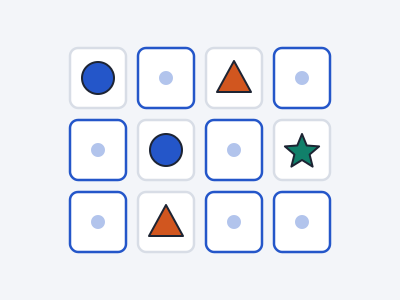
- Shape: circle, square, triangle and others repeat in a fixed order, such as circle, circle, square.
- Fill: solid, striped, dotted or outlined. Each fill also has its own color, but the pattern inside the shape is always enough on its own, so color is never the only clue.
- Size: small, medium and large take turns.
- Direction: an arrow or triangle turns a quarter turn each step, clockwise or counter-clockwise.
On Easy only the shape changes. On Medium, usually two things change at once, each with its own rhythm. On Hard up to three things change, and the gap is sometimes in the middle of the row instead of at the end.
Controls
- Mouse or touch: tap an answer, then tap Next.
- Keyboard: after pressing Start, focus lands on the first answer. Use the arrow keys to move between answers and Enter or Space to choose. Focus then moves to the Next button.
- Screen readers: every place in the row is described in words, such as "large striped triangle", and each answer choice is labeled the same way, so the game can be played without seeing the shapes.
What the game asks of you
Pattern Challenge asks you to compare items side by side, notice what stays the same and what changes, and check a guess against the whole row rather than just the last item. These are the same habits used in many classroom pattern activities. It is a puzzle game, not a test, and we do not claim it measures or raises intelligence.
Tips for each level
Easy. Point at each shape and say its name out loud. Listen for where the list starts again: "circle, square, triangle, circle, square, triangle". The gap is the next word in the chant.
Medium. Look at one feature at a time. Cover the colors with your mind and read only the shapes; then read only the fills. Each feature repeats on its own, and the answer has to satisfy both. If two answers share the right shape, the fill decides.
Hard. Count how long each cycle is. A fill pattern that repeats every three and a shape pattern that repeats every two will not line up neatly, so find the gap's position in each cycle separately. When the gap is in the middle, use items on both sides of it to check.
Play it on paper or with objects
Buttons, blocks, cutlery or colored pencils all make good pattern pieces. Lay out a row, hide one item under a cup, and let the other player work out what is under it. Then swap roles: inventing a pattern that someone else can solve is a good test of whether you really understand the rule. Ask older children to make a pattern with two rules running at once.
At home and in the classroom
Because every round ends with an explanation, the game works well for talking through reasoning together. Try pausing before answering and asking each person to say what rule they think is in play. In a class, the same seeded puzzle can be repeated with Restart, so a group can discuss the same rounds. Best scores stay in this browser only and can be cleared with Reset my progress.